Tooth KnowLedge
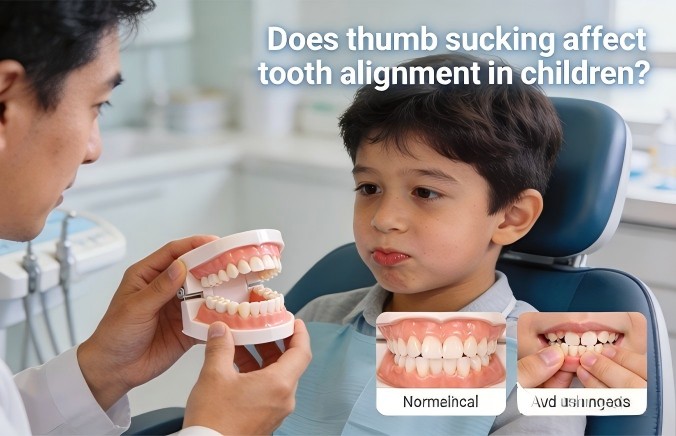
Does thumb sucking affect tooth alignment in children?
16mins Read
Last Updated :Advertisement
What Do the Effects Actually Look Like?
When thumb sucking does affect tooth alignment, it’s not just one thing—it can cause a few different issues, depending on how your kid sucks their thumb. Let’s keep this simple (no fancy dental terms, I promise) and go over the most common problems you might see. And remember: these don’t happen overnight—they take years of consistent, intense thumb sucking to show up.
1. Protruding Front Teeth (AKA “Buck Teeth”)
This is the most common effect, and it’s exactly what it sounds like: the top front teeth stick out more than they should. When your kid sucks their thumb, their thumb is wedged between their top and bottom front teeth. Over time, that constant pressure pushes the top teeth forward and the bottom teeth backward. The result? Teeth that look like they’re “sticking out”—hence the nickname “buck teeth.”
This isn’t just a cosmetic issue, either. Protruding front teeth can make it hard for your kid to close their mouth all the way, which can lead to dry mouth (and bad breath). They’re also more likely to get hurt if they fall—those front teeth are sticking out, so they’re more prone to chipping or breaking. Plus, it can affect their speech (more on that later).
2. Open Bite
An open bite is when the top and bottom front teeth don’t touch when your kid closes their mouth. Imagine biting down—if their front teeth are apart, even a little, that’s an open bite. This happens because the thumb is constantly in the way, preventing the front teeth from growing together properly.
An open bite can make it hard for your kid to chew (they might have to bite with their back teeth) and can cause speech problems, like a lisp. It can also lead to improper swallowing habits, which can make the problem worse over time. The good news? If caught early, an open bite from thumb sucking is usually reversible with orthodontic treatment.
3. Crossbite
A crossbite is a little trickier to spot, but it’s just as common. It happens when the top teeth fit inside the bottom teeth, instead of on top of them. This usually happens because thumb sucking puts pressure on the sides of the mouth, which can narrow the upper jaw. Over time, the upper jaw doesn’t grow properly, leading to the top teeth shifting inward.
If a crossbite isn’t corrected, it can cause the jaw to shift to one side (making their face look lopsided) and can lead to uneven wear on the teeth. It can also cause jaw pain later in life, so it’s important to catch it early. My neighbor’s son had a crossbite from thumb sucking, and once he stopped, his dentist was able to correct it with a small orthodontic appliance—no braces needed.
4. Narrow Palate (Roof of the Mouth)
The roof of your kid’s mouth (the palate) is soft and flexible when they’re young, so constant pressure from thumb sucking can make it narrow. A narrow palate can lead to crowded teeth—there’s not enough room for all the permanent teeth to grow in straight. It can also cause mouth breathing, which has its own set of issues (like dry mouth and increased risk of cavities).
The key takeaway here: these effects don’t happen overnight. It takes years of consistent, intense thumb sucking to cause noticeable changes. If your kid stops by age 5, you probably won’t see any of these issues. But if they keep going past age 6, it’s worth keeping an eye on. And even if you do notice a little change, it’s not the end of the world—orthodontists can fix most of these problems with early intervention.
Advertisement
Advertisement
Tips For Getting Free Dental Work
1. Be prepared to provide documentation of your income and place of residence.
Many free dental clinics require patients to provide proof of income and residence in order to qualify for services.
2. Call ahead to schedule an appointment.
Most free dental clinics require patients to make an appointment in advance.