Tooth KnowLedge
What damage does the habit of biting hard objects cause to teeth?
20mins Read
Last Updated :Advertisement
These everyday habits are actually damaging your teeth.
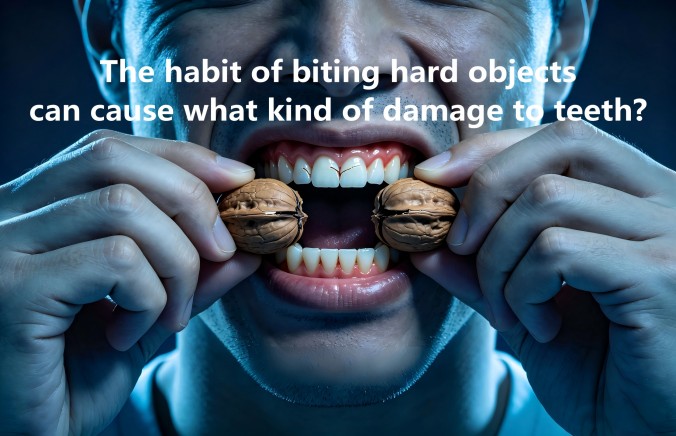
You might think it's cool and convenient to open a beer bottle with your teeth at a gathering with friends; you might find it addictive to chew hard nuts while watching TV; or you might unconsciously bite your nails or chew on a pen when you're stressed or anxious—do you often do these seemingly ordinary things? Many people think that teeth are the hardest organ in the human body, and biting hard objects is no big deal. However, they don't realize that every "hard-on-hard" action is planting the seeds of future damage to their teeth.
Teeth, though hard, are surprisingly brittle. Like a porcelain bowl, they're fine for everyday use, but a strong impact can cause cracks or even break them. Our teeth are covered by enamel, the hardest tissue in the human body, with a hardness comparable to crystal. However, it has a fatal weakness: it cannot regenerate and is brittle and cannot withstand shear forces. Frequent or prolonged biting of hard objects is like repeatedly striking a porcelain bowl. Even the strongest tooth enamel will gradually deteriorate, leading to a series of oral problems. Most of this damage is irreversible; by the time significant pain occurs, it's often too late to reverse the damage.
The Most Easily Overlooked Damage: Excessive Tooth Wear
The most common and easily overlooked damage is excessive tooth wear. Many people chew nuts, bones, and ice cubes for extended periods, thinking it's a minor matter, unaware that each chewing action wears down the enamel. Tooth enamel acts like the tooth's "protective armor." Repeatedly biting hard objects thins and flattens this armor, causing teeth to shorten and become thinner. The once sharp cusps are worn down, significantly reducing chewing efficiency. Even more distressing is the increased sensitivity of worn teeth. Drinking ice water or eating sweets can cause excruciating pain. This is because the worn enamel exposes the dentin underneath—which contains numerous tiny tubules that directly transmit stimuli like hot, cold, acid, and sweet flavors, making the teeth extremely fragile.
More dangerously, long-term wear and tear can lead to malocclusion and even reduce the height of the lower third of the face, affecting facial aesthetics. This is especially true for children and the elderly. Children's tooth enamel is not fully developed and is thinner; biting hard objects for extended periods can affect normal tooth development. The enamel of the elderly naturally wears down with age, and biting hard objects accelerates this damage, exacerbating tooth sensitivity and loosening.
The Development of Tooth Cracks: From Asymptomatic to Extraction
In the early stages of a tooth crack, the crack is only on the surface of the enamel and may be asymptomatic. As the crack deepens and reaches the dentin, it causes sharp, localized pain when biting, which worsens when eating hot or cold foods. If ignored, the crack can extend into the pulp chamber, causing pulp infection and severe spontaneous pain, even at night, preventing sleep. Even more seriously, when the crack penetrates the tooth, it may suddenly split unexpectedly, ultimately requiring extraction. Clinically, many patients only seek medical attention when the toothache becomes unbearable due to prolonged biting of hard objects. By then, the cracks are already deep, significantly increasing the difficulty and pain of treatment.
Besides wear and tear and microcracks, biting hard objects can also lead to loose teeth and even tooth loss. Healthy teeth, tightly connected to the alveolar bone by periodontal ligament fibers, are like the roots of a tree anchored in the soil, possessing a certain degree of physiological mobility and capable of withstanding normal chewing forces. However, prolonged biting of hard objects subjects teeth to excessive and uneven biting forces. Habitually biting hard objects on one side, in particular, causes chronic trauma to the periodontal ligament and alveolar bone, much like repeatedly shaking a tree, gradually loosening the roots and eroding the soil.
Advertisement
Advertisement
Tips For Getting Free Dental Work
1. Be prepared to provide documentation of your income and place of residence.
Many free dental clinics require patients to provide proof of income and residence in order to qualify for services.
2. Call ahead to schedule an appointment.
Most free dental clinics require patients to make an appointment in advance.