Dental Implant
Dentures that constantly fall out or become unstable – choose dental implants to say goodbye to life's troubles
15mins Read
Last Updated :Advertisement
Dental implants are here to completely eliminate the problems of missing teeth.
"My dentures suddenly fell out of my bowl while I was eating, causing me immense embarrassment in public; my speech became slurred, and I was always afraid to speak up; my dentures loosened at night, causing gum pain and keeping me awake at night..." This is not an isolated phenomenon, but a daily predicament for countless denture wearers. According to relevant data, over 70% of denture wearers have experienced dentures falling out or becoming loose. This long-term problem not only affects eating and communication but also gradually erodes oral health and self-confidence. Now, with the continuous advancement of dental implant technology, dental implants have become the preferred solution to the problems of dentures, allowing countless people with missing teeth to regain stable "new teeth" and a carefree life.
Unstable Dentures: The Embarrassment and Hidden Dangers in Daily Life
For people with missing teeth, dentures were once the primary option for restoring chewing function. However, after years of wearing them, the problems of dentures falling out and loosening become a persistent issue, causing more trouble than imagined. Many wearers admit that the most embarrassing moment is when they are dining with others and take a bite of a hard dish, only to have their dentures suddenly shift or even fall out. They can only quickly cover it up, and the mood for eating is completely ruined. Even more frustrating is that to prevent dentures from falling out, they have to eat soft, mushy foods year-round. Over time, this not only leads to a decreased appetite but also affects gastrointestinal health and the body's immunity due to insufficient nutrient intake.
Besides the embarrassment, unstable dentures also pose many hidden health risks. Wearing loose dentures for a long time will repeatedly rub against the gums, causing redness, swelling, bleeding, and inflammation. In severe cases, it can even lead to periodontal disease. The gaps between the dentures and the gums can easily trap food debris and bacteria, creating bad breath, affecting oral hygiene, and even accelerating alveolar bone resorption, greatly increasing the difficulty of subsequent restorations. Furthermore, long-term reliance on dentures can lead to facial muscle relaxation, drooping corners of the mouth, and making one appear several years older. This can cause many wearers to gradually become self-conscious, reluctant to socialize, and quietly close the "door" to life. The root of all this lies in the fact that traditional dentures rely primarily on base adhesion or support from adjacent teeth for retention, unlike natural teeth which are rooted in the alveolar bone. Once the alveolar bone atrophies and the mucosa loosens, dentures can become loose and fall out, failing to fundamentally solve the problem.
Dental Implants: More Than Just "Filling a Tooth," It's Rebuilding a New Oral Health Ecosystem
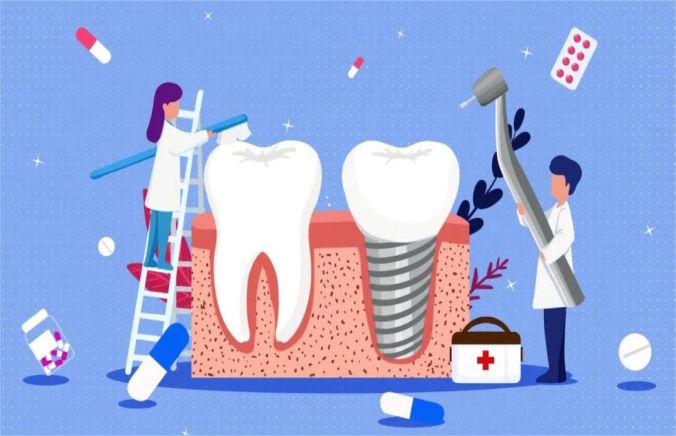
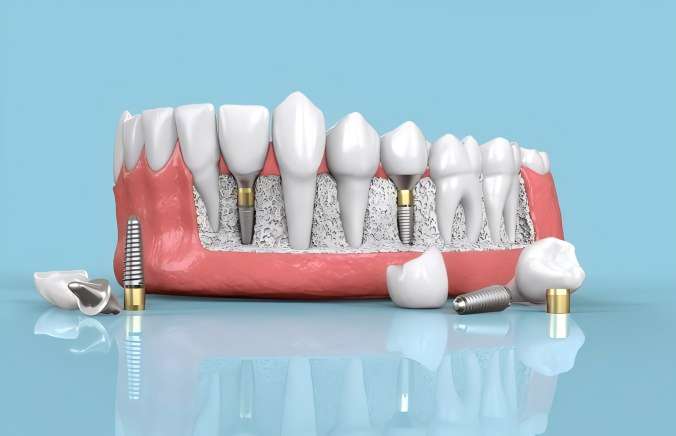
Faced with the many drawbacks of dentures, dental implants have completely broken the deadlock in tooth replacement. Unlike traditional dentures, dental implants involve surgically implanting an artificial tooth root (implant) into the alveolar bone at the site of the missing tooth. After the implant has formed a strong osseointegration with the alveolar bone, a crown is then installed, mimicking the structure and function of a natural tooth, achieving "root-like" retention and fundamentally solving the problem of dentures falling out and becoming unstable.
Compared to traditional dentures, the advantages of dental implants are truly "comprehensive and overwhelming." First, dental implants are extremely stable. The artificial tooth root integrates tightly with the alveolar bone, just like a natural tooth rooted in the mouth. Whether chewing hard foods, talking, sneezing, or laughing, they will not loosen or fall out, completely relieving the wearer of the psychological burden of "fearing tooth loss." Second, dental implants have a much higher chewing efficiency than dentures. They can transmit chewing pressure like natural teeth, allowing wearers to once again enjoy the pleasure of gnawing on ribs and biting into apples, without worrying about dietary restrictions. More importantly, dental implants do not require grinding down adjacent teeth or wearing cumbersome bases and clasps, offering extremely high comfort. After wearing them, there is almost no foreign body sensation, and they can effectively prevent alveolar bone resorption, protecting oral health. At the same time, aesthetics are also important. The crown can be customized according to the color and shape of one's own teeth, achieving a lifelike appearance and making facial lines appear fuller and more natural.
Advertisement
Advertisement
Tips For Getting Free Dental Work
1. Be prepared to provide documentation of your income and place of residence.
Many free dental clinics require patients to provide proof of income and residence in order to qualify for services.
2. Call ahead to schedule an appointment.
Most free dental clinics require patients to make an appointment in advance.